Artificial intelligence is transforming from being a passive answer machine into something proactive, meaning it can plan, act, or make decisions on its own for us. Conventional AI like Chatbots, provides a reactive kind of assistance it responds when you act upon it manually. However, the agentic kind operates under an innovative paradigm it’s self-directed, meaning it can think and act upon goals without constantly relying on humans for supervision. Unlike any other artificial intelligence, an agentic one thinks AND does.
Agentic AI has brought about the genAI paradox whereby organizations have broadly adopted AI yet have noticed little effect. According to McKinsey, “AI agents have the potential to automate complex business processes combining autonomy, planning, memory, and integration to shift gen AI from a reactive tool to a proactive, goal-driven virtual collaborator”. In practical terms, this would mean AI assistants that not only answer questions, but set their own sub-tasks and act on them. For instance, it would study a company’s data, identify a problem, come up with a solution, and implement it, learning from the process and outcome.
AI Agent vs Chatbot
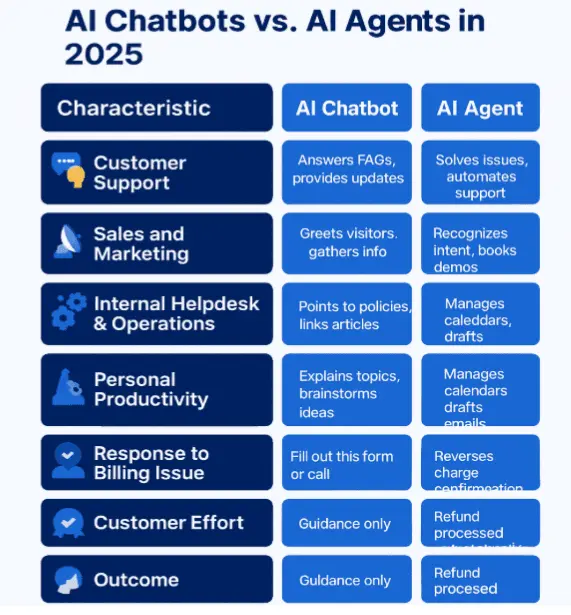
Chatbot or Traditional AI:
It responds to each individual prompt or question in isolation. Traditional AI performs well in clearly defined and concrete tasks but mostly has to be guided by human intervention for the subsequent step. In short, the conventional AI “awaits instruction and responds to prompts”. It functions as an assistant in demand.
Agentic AI:
Agentic AI is a goal-oriented and self-directed system." They are also able to “break down complex goals into manageable steps, utilize tools, and work through problems on their own”. Other strengths of the agentic AI system are their ability to possess memory and develop plans independently, enabling them to accomplish multi-step goals. This includes, instead of summarizing meeting minutes, reading meeting minutes and notifying team members about action items in a project-management tool automatically, without having to be instructed to complete these tasks separately. This is referred to as "multi-agent collaboration, dynamic task decomposition, persistent memory, and coordinated autonomy” by researchers
In short, agentic AI plans, decides, and executes, whereas traditional AI merely responds.
Real-world examples illustrate this shift:
- Traditional chatbots or virtual assistants answer FAQs or carry out scripted interactions. In contrast, agentic AI can initiate tasks. For example, a virtual customer service agent might proactively open a support ticket, search a knowledge base for solutions, apply a fix, and follow up with the customer all in one continuous process
- An AI receptionist can autonomously handle incoming calls, book appointments, and even update CRM records by itself. Traditional AI could only answer each call’s questions; agentic AI can decide the next steps (e.g. “book meeting, update CRM, send confirmation SMS”).
- In operations, agentic systems can constantly monitor metrics and trigger actions: for instance, watching sales dashboards to spot a sudden drop, diagnosing the cause, and alerting the team with proposed solutions without waiting for a human to notice
Agentic AI at work might look like a virtual receptionist handling calls, scheduling, and messages autonomously. For example, an AI receptionist uses natural language understanding to answer questions and can “route inquiries, schedule appointments, and respond to FAQs in real time” by itself. This goes well beyond a simple IVR system; the AI works updating databases, checking calendars, and managing follow-ups until the task is done.
In summary, agentic AI adds autonomy, adaptability, and decision-making to the AI toolkit. Instead of issuing a prompt and getting one answer, you can set a goal and have the system determine how to achieve it. As one perspective notes: “Traditional AI is reactive. You ask, it answers. Agentic AI is proactive. You set a goal; it figures out how to achieve it”. This fundamental shift enables far richer applications.
What is Agentic AI?
Agentic AI can seem like a buzzword, but it has specific meaning in the emerging literature. Exabeam defines agentic AI as AI systems with built-in autonomy and decision-making capabilities that “interpret data, learn from interactions, and drive decisions or actions without explicit human intervention”. These systems are consciously contrasted with traditional or generative AI: whereas a chatbot or LLM only generates responses to prompts, an agentic AI “incorporates a broader understanding of contexts and objectives” and can even take actions in the real world
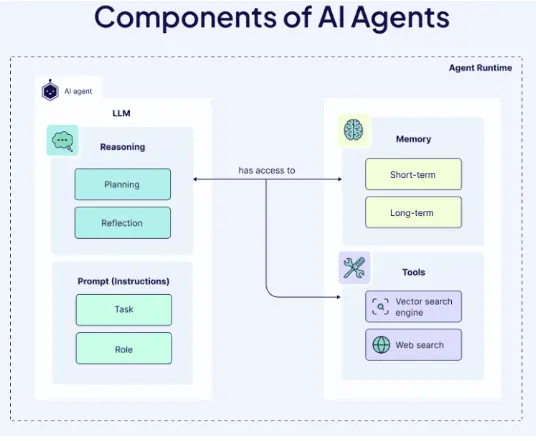
Formally, researchers distinguish AI Agents and Agentic AI. AI Agents are modular tools that use AI components for specific tasks for example, an LLM plus plugin that automates scheduling. But Agentic AI is viewed as a paradigm shift: systems composed of multiple interacting agents or modules, with persistent memory and autonomy to break down and pursue complex goals. In one taxonomy, AI agents are seen as an evolution from generative models (using tool integration and prompt engineering), while true agentic AI is characterized by multi-agent collaboration and dynamic task decomposition.
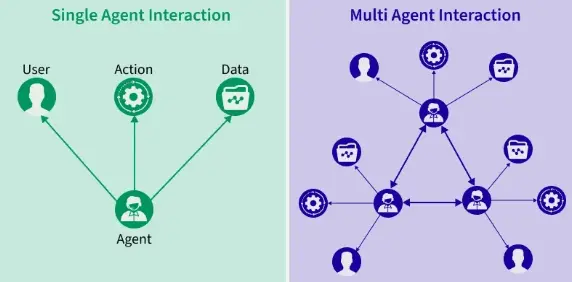
To put it another way, imagine an AI agent as a smart tool (like a chatbot that calls an API to book a meeting), whereas agentic AI is the entire autonomous workflow (figuring out what meeting to book, when, with whom, and executing the whole process end-to-end). McKinsey also highlights this distinction: generative AI is reactive (content-by-prompt), but agentic AI executes tasks on its own mandates. As one expert notes, an agentic AI “perceives reality based on its training, decides, applies judgment, and executes something. And that execution then reinforces its learning.” In short, agentic AI can learn from its actions and adapt much like a digital employee.
The architecture of agentic AI often involves many interconnected components & multiple intelligent nodes (agents) collaborating and sharing data. Research describes agentic AI systems as featuring multi-agent collaboration, dynamic task decomposition, persistent memory, and coordinated autonomy. In practice, this means different AI modules work together: one agent might analyze a problem, another fetch data, another execute a command, with the whole system remembering past interactions. This multi-agent coordination enables agentic systems to operate in complex, changing environments, far beyond what single step chatbots can do.
How Agentic AI Works?
While specific architectures vary, most agentic systems share a general workflow: Perceive → Reason → Act → Learn. In each cycle, the AI agent:
-
Perceives the environment. It gathers data from inputs user prompts, system states, databases, sensor readings, etc. and processes it to build a situational understanding.
-
Reasons about goals. A language model or reasoning module interprets the goal (explicit or implied) and plans the steps needed. It may consult external knowledge (via retrieval or tools) and uses contextual memory. Agentic systems often use retrieval-augmented generation and other techniques to keep their planning accurate over time.
-
Acts by executing tasks. The agent carries out the planned actions through APIs, software tools, or even robotic controls. Importantly, it integrates with real systems: sending emails, updating records, controlling devices, etc., as needed. For instance, an agent could place an order with a web API, trigger an IoT device, or launch a database query on its own.
-
Learn from outcomes. After acting, the system evaluates success (automatically or via feedback) and updates its internal models or memory. This continual loop lets the agent improve: if its action solves the problem, it reinforces that strategy; if not, it tries alternatives.
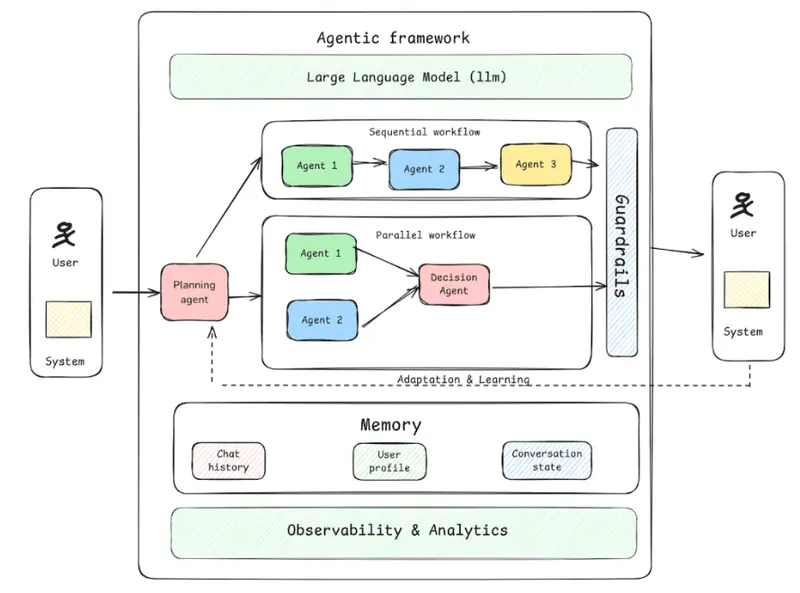
This structured flow has been outlined by NVIDIA and others as the foundation of agentic AI systems. Because agents adjust their behavior based on new information, they can handle uncertainty and novelty. Over time, as agents refine their strategies, they become more efficient and reliable, much like human teams optimizing their processes.
From an engineering standpoint, building agentic AI also involves setting guardrails and governance. The system needs constraints (ethical, security, operational) to ensure it acts safely.
Real-World Use Cases of Agentic AI
Agentic AI is already finding practical applications across business functions. In many cases, it simply accelerates what AI assistants have been doing, taking them several steps further. Key examples include:
Virtual Receptionists and Call Handling:
AI receptionists can answer calls and schedule appointments 24/7. Modern solutions use natural-language processing to understand callers' needs. They then autonomously update calendars or CRM systems as needed. For instance, an AI front-desk system can route inquiries, book meetings, or send SMS confirmations without human intervention[9]. This not only ensures no call is missed, but it frees human staff to focus on complex tasks.
Intelligent Data Monitoring:
Agentic AI can continuously watch over business data and trigger alerts or fixes. For example, if sales suddenly dip, an AI agent might investigate recent campaigns, identify likely causes, and notify the marketing team with recommendations
End-to-End Customer Support:
Beyond chatbots, agentic AI in customer service can handle entire cases. It can recognize a support request, pull in account info, create or update a support ticket, suggest solutions from the knowledge base, and even follow up with the customer once resolved. This level of automation has been noted to transform support: one survey found 93% of companies expect AI to deliver more personalized, proactive services.
Workflow Automation (No-Code Integration):
Platforms like n8n and Make enable non-technical users to build agentic automations by connecting AI modules with apps. For instance, you could configure an agent that reads incoming support emails, categorizes them using an LLM, and then routes tasks to team members via Slack or ticketing tools. n8n’s blog highlights that such platforms make it easier to build, customize, and scale AI agents for real-world work.
Operations and Supply Chain:
Major companies are already using agentic AI to optimize logistics. For example, Amazon employs intelligent agents to synchronize inventory levels with demand forecasts, automatically adjusting orders and shipments to ensure smooth delivery even as conditions change
Platforms and Tools for Agentic AI
The rise of agentic AI has also spurred new tooling. Tool integrations and automation platforms are crucial enablers. For example:
- n8n / Make / Zapier: These no-code tools let users create workflows where AI steps can call APIs, run code, or access databases. You might chain an OpenAI or Claude model output to trigger an HTTP request, file an issue in Jira, or send data to a warehouse all without custom engineering. This allows complex agentic scenarios to be assembled from blocks.
- AI Agent Frameworks: There are libraries and services specifically for building agents. For instance, the LangChain ecosystem (Python tools like LlamaIndex, AgentExecutor, etc.) provides reusable components for memory, tool use, and feedback loops.
- Enterprise AI Platforms: Big tech is packaging agentic capabilities into enterprise tools. Some analytics platforms now incorporate AI assistants that not only answer queries but can autonomously generate and run business reports on schedule. Customer service software (like IBM Watson or Salesforce Einstein) is adding agentic modules for case routing and resolution.
These tools are making agentic AI more accessible. As one source notes, the industry is moving from traditional rule based workflows to more dynamic, intelligent systems that can adapt and make decisions in real time
Challenges and Considerations
While promising, agentic AI brings risks that businesses must address:
- Hallucinations and Errors: Autonomous agents can still hallucinate or make incorrect inferences, just as LLMs do. When acting on their own, a hallucination might lead to wrong actions (e.g. sending a mistaken email or ordering the wrong part). Such are mitigated by safeguards, like retrieval-augmented checks, human review for critical decisions, or confidence thresholds.
- Brittleness and Coordination Failures: Multi-step agents sometimes get stuck or loop in case one of the subtasks fails. Researchers point to the risk of coordination failure where different parts of an agentic system misalign. Robust error handling is therefore required, accompanied by contingency planning-including, for example, fallback rules or supervisor agents that take over.
- Complexity and Resource Use: Agentic AI systems tend to consume more compute (making multiple model calls, integrating various tools). Businesses should consider infrastructure and cost implications.
- Governance and Ethics: Agents working across systems have to adhere to privacy, security, and compliance. They may require new policies on matters of the type of data to be accessed automatically by the agent. They should reflect on the ethical issue of minimizing human intervention.
However, experts are optimistic about solutions. Methods such as ReAct loops, the use of retrieval for augmentation of generation, and modeling causality might improve accuracy. Adding explainability (such as tracing decision-making for the agent) encourages trust. Like all pervasive technologies, success requires integrating good technical solutions with effective change management.
The Future of AI in Action
The shift from “thinking” AI to “acting” AI is accelerating. As one summary puts it, the future “isn’t just AI that thinks it’s AI that acts.” Organizations that embrace agentic AI now can create new levels of automation and innovation.
Within the next few years, we should see the emergence of agentic AI that goes past the digital realm into the physical world. This is already being researched in terms of robotics and IoT, such as autonomous drones that manage deliveries, as well as manufacturing AI that manages the supply chain. However, the technology is growing very fast, as reflected in the warning in the November 2025 paper published in a Stanford/Harvard journal that many current implementations of agentic AI “completely fall apart in real world usage” though this remains an active area of development.
In conclusion, it is evident that, in the realms of chatbots and co-workers, a new way of working for us is emerging in the form of AI. And for entrepreneurs and technology experts, this heralds a new way of understanding how the workflow of the future could look in terms of collaboration with AI co-workers. This would make for a highly adaptable enterprise because, in the future, agenticAI would objectively take care of the routine or time consuming work, and the experts would focus on the creative and strategic part of the process. In this way, a company that uses agenticAI effectively will turn novelty into measurable value transforming AI from a passive assistant into an active partner in growth and efficiency.
Sources: The content above draws on recent industry research and expert articles on agentic AI. Key references include McKinsey reports, Exabeam’s agentic AI guide, technology blogs (n8n, Capacity), and corporate AI studies, among others, to ensure a comprehensive, reference-based discussion.
Agentic AI: How It Works and 7 Real-World Use Cases | Exabeam
Building and managing an agentic AI workforce | McKinsey
Seizing the agentic AI advantage | McKinsey
https://www.mckinsey.com/capabilities/quantumblack/our-insights/seizing-the-agentic-ai-advantage
Agentic AI vs Traditional AI 2025: Explore the Shift
https://kanerika.com/blogs/agentic-ai-vs-traditional-ai/
[2505.10468] AI Agents vs. Agentic AI: A Conceptual Taxonomy, Applications and Challenges
https://arxiv.org/abs/2505.10468
Agentic Meaning in AI: 7 Ways It's Transforming Business in 2025
https://capacity.com/blog/agentic-meaning/
AI Receptionists: Automated Service for Busy Businesses
https://www.nextiva.com/blog/ai-receptionist.html
15 Practical AI Agent Examples to Scale Your Business in 2025 – n8n Blog
https://blog.n8n.io/ai-agents-examples/
Agentic AI vs. Traditional Automation: What Sets It Apart
https://info.calltower.com/blog/agentic-ai-vs.-traditional-automation-what-sets-it-apart
This AI Paper from Stanford and Harvard Explains Why Most ...