Loading

Cross-Platform App Development Services

Cross-platform app development services are redefining how businesses build and scale digital products. In this modern and fast-moving market, companies do not have the time or budget to create and maintain separate native apps for iOS, Android, and the web. Industry reports show that cross-platform development can reduce total engineering time by up to 40% without compromising on performance or user experience. That’s why investing in Cross-Platform App Development Services has become one of the most strategic moves a business can make. With a single, shared codebase, teams can deliver apps that run seamlessly across devices while still feeling native to every platform.

Over the past few years, the right Cross-Platform App Development Framework has proven to be a game-changer—reshaping delivery timelines, reducing maintenance costs, and streamlining scalability. In this blog, we’ll explore the frameworks defining 2025: from Flutter and React Native to .NET MAUI; along with real-world insights from modern development teams.

What Is Cross-Platform Mobile Development?

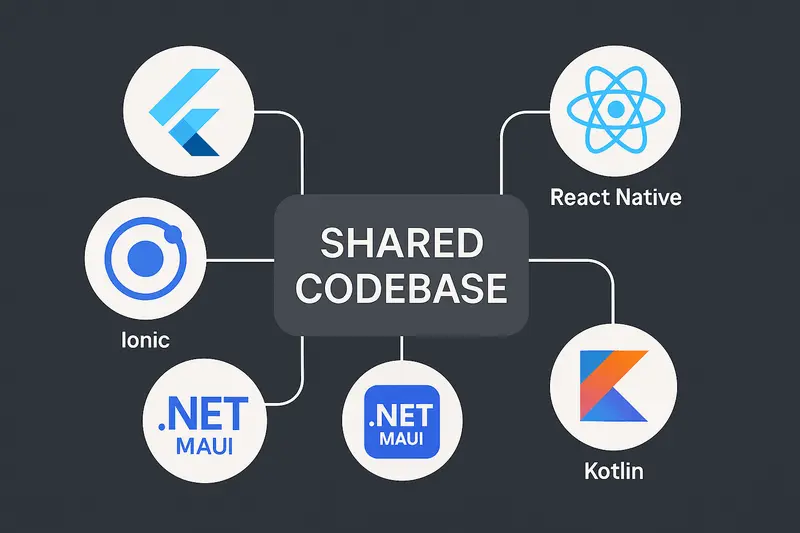
Cross-platform mobile development is the practice of building software that works on multiple operating systems — mainly Android, iOS, Windows, and web — using one shared codebase.. Developers often choose a Cross-Platform App Development Framework not just for its efficiency but for consistent API behavior and smoother deployment cycles — two areas that drastically cut post-launch bugs. The results are clear:

  • Lower development cost
  • Shorter time-to-market
  • Easier maintenance and updates
  • Unified user experience (UX)

Frameworks like Flutter, React Native, and Ionic have evolved to the point where they deliver native-like performance with direct access to device APIs. That’s why companies aiming for faster scaling and wider market reach are adopting this model more than ever before.

The Best Cross-Platform App Development Frameworks

The landscape of Cross-Platform App Development Frameworks has evolved rapidly. From Dart to Kotlin and JavaScript to C#, each ecosystem serves a different development philosophy. Below is an expert comparison of the six most trusted frameworks shaping 2025.

Explore our Custom App Development Service to see how these frameworks can be used to build high-performance, scalable applications tailored to your business goals.

1.Flutter

Flutter, developed by Google, has rapidly become a favourite among developers. One often overlooked advantage of Flutter is its predictable rendering pipeline, which helps avoid the subtle UI inconsistencies developers usually face between Android and iOS. Built on the Dart programming language, Flutter compiles to native machine code and uses its own rendering engine — meaning apps look and perform the same across Android, iOS, and web.

Key advantages:


  • Hot reload for real-time code updates
  • Material and Cupertino widgets for native design consistency
  • Custom rendering engine ensures fast, smooth UI performance
  • Strong developer community and ecosystem

Used by: Google Pay, Alibaba, eBay Motors

When to use Flutter: Ideal for startups and design-centric projects where performance and UI consistency matter most.

2. React Native

Created by Meta (Facebook), React Native uses JavaScript and React to build cross-platform apps that look and feel native. With React Native, performance largely depends on managing the JavaScript bridge efficiently; using libraries like Reanimated 3 or Hermes can make a measurable difference. It is one of the most established frameworks, trusted by enterprises worldwide.

Key advantages:


  • Reusable components and shared logic across platforms
  • Fast Refresh for live updates
  • Vast ecosystem of plugins and community tools
  • Near-native performance and easy integration with native modules

Used by: Facebook, Instagram, Skype, Shopify

When to use React Native: When you need a balance between rapid development, scalability, and existing JavaScript expertise

3. Kotlin Multiplatform (KMP)

Teams transitioning from Android find Kotlin Multiplatform particularly cost-effective, since existing Kotlin logic can be reused directly with minimal refactoring. From JetBrains, Kotlin Multiplatform allows developers to share business logic across mobile, web, and desktop apps while keeping native UIs. It’s a flexible, modern solution for teams already working in Kotlin.

Key advantages:


  • Shared code for Android, iOS, web, and desktop
  • Native UI flexibility with Compose Multiplatform
  • Easy integration with existing native projects
  • Backed by JetBrains and Google, ensuring long-term stability

Used by: Netflix, McDonald’s, 9GAG

When to use KMP: Perfect for large teams who want to merge native and cross-platform benefits without rebuilding from scratch.

4. Ionic Framework

Ionic has been serving developers since 2013, using web technologies like HTML5, CSS, and JavaScript to create hybrid and progressive web apps. Integrated with Angular, React, or Vue, Ionic offers unmatched flexibility for web-first projects.

Key advantages:


  • Large library of pre-built UI components
  • Access to native APIs through Capacitor and Cordova
  • Web-first performance and progressive web app support
  • Fast iteration and easy deployment

Used by: T-Mobile, BBC, EA Games

When to use Ionic: Ideal for businesses with existing web teams looking to build mobile apps quickly with familiar technology.

Also read about what to choose for your next development, iOS or Android

5. .NET MAUI (Multi-platform App UI)

Successor to Xamarin, .NET MAUI is Microsoft’s official cross-platform solution. It allows developers to build apps for Android, iOS, macOS, and Windows using a single project in C# and XAML.

Key advantages:


  • Unified project system covering all platforms
  • Full access to native APIs like camera, GPS, and sensors
  • Deep integration with Azure and Microsoft tools
  • Supported by Microsoft’s large developer community

Used by: NBC Sports Next, Escola Agil

When to use .NET MAUI: Best for enterprises already within the Microsoft ecosystem that value security, reliability, and long-term support.

6. NativeScript

NativeScript lets developers create truly native apps using JavaScript, TypeScript, Angular, or Vue. It gives direct access to native APIs without needing additional bridges, delivering performance on par with native development.

Key advantages:


  • Direct access to device capabilities
  • Full control over native UI and performance
  • Flexible use of popular JavaScript frameworks

Used by: SAP, Deloitte, Symantec

When to use NativeScript: For teams that want JavaScript simplicity but full native power.

Also Know about programming languages popular for AI Development

How to Choose the Right Cross-Platform Framework

Choosing a Cross-Platform App Development Framework should start with understanding how your business defines success — faster deployment, long-term maintainability, or broader user reach.. Here’s what you should evaluate before choosing one:


  • Programming language familiarity (Dart, JavaScript, C#, or Kotlin)
  • Performance requirements — does your app demand native speed or hybrid flexibility?
  • UI/UX complexity and customization goals
  • Integration needs with back-end systems or APIs
  • Community support and longevity of the framework

At SaerinTech, we perform a technical discovery phase before development. This ensures we pick the most efficient, maintainable, and future-proof stack for each client — whether it’s Flutter for visual excellence or .NET MAUI for enterprise reliability.

Our Custom Web App Solutions help businesses integrate these frameworks seamlessly with existing systems to achieve true cross-platform scalability.

Why Choosing the Right Development Approach Matters

Many teams underestimate how much early architectural decisions impact post-launch costs. I’ve seen projects save months of maintenance time simply by aligning their architecture early with the chosen framework’s lifecycle. The success of any cross-platform app doesn’t just depend on the framework you pick — it depends on how well performance, scalability, and user experience come together.

A well-built system should feel effortless for users and dependable for teams maintaining it. That means:


  • Optimizing performance early to prevent bottlenecks later
  • Designing integrations carefully so web and mobile stay in sync
  • Building with security and scalability in mind to avoid painful rebuilds

Every app, whether it’s a quick MVP or a full-scale enterprise platform, deserves the same engineering discipline — clean architecture, efficient code, and a focus on long-term stability. The right technical decisions made today are what make products adaptable tomorrow.

Final Thoughts

Cross-platform frameworks are beyond cost-cutting tools , they are now the backbone of modern digital ecosystems.Technologies like Flutter, React Native, and Kotlin Multiplatform empower developers to deliver native-like experiences with less complexity, faster iterations, and broader reach.

If you’re planning your next app, take time to evaluate your needs, performance, budget, scalability, and design priorities. Whether you’re exploring your first MVP or scaling an enterprise product, understanding how these frameworks differ is the key to sustainable software delivery.

For teams needing technical evaluation or stack consulting, Saerin Tech’s cross-platform development experts can guide your strategy.