Ranking on Google is no longer only about appearing on page one. With AI Overviews, users can now see summarized answers directly in search results, often before clicking a website.
The mistake many businesses are making is simple: they are still judging SEO only by rankings, while search results are becoming more answer-driven. Your content now has to do more than hold a ranking position. It must be clear, helpful, well-structured, and trustworthy enough to be selected as a source for AI-generated answers.
This guide explains how to optimize content for Google AI Overview in 2026 using AI SEO, search intent, answer-ready formatting, internal linking, and technical SEO.
Quick Answer
To rank in Google AI Overview, create content that answers the search query clearly, matches search intent, covers related questions, uses clean headings, demonstrates expertise, and is easy for Google to crawl and understand. AI Overview visibility depends on helpful content, topical relevance, authority, structure, freshness, and trust. It does not depend on keyword stuffing or any special AI schema trick.
Google’s own guidance for AI features says the same foundational SEO best practices still apply, including helpful content, technical accessibility, internal links, page experience, and structured data that matches visible content.
The 5C Framework for Google AI Overview Optimization
| Factor | What it means | What to do |
|---|---|---|
| Clarity | Google can quickly understand the answer. | Add a direct answer in the first 100 words. |
| Context | The page covers related questions. | Add supporting subtopics and follow-up questions. |
| Credibility | The content shows trust and expertise. | Add author bio, sources, examples, and experience. |
| Crawlability | Google can access the content. | Fix indexability, headings, schema, and internal links. |
| Conversion | The page guides users to the next step. | Add relevant CTA and service-page links. |
What is Google AI Overview?
Google AI Overview is a search feature that uses generative AI to provide summarized answers directly in Google Search results. Instead of only showing traditional blue links, Google may show an AI-generated summary with supporting sources and related context. This helps users understand a topic faster without opening several pages one by one. For businesses, this creates both a challenge and an opportunity. The challenge is that users may click fewer traditional results when the answer is already visible on Google. The opportunity is that if your content becomes one of the sources Google finds useful, your brand can appear where users are paying attention first. That is why Google AI Overview SEO is becoming an important part of modern SEO strategy.
What Google AI Overview Is Not
Google AI Overview is often misunderstood. It is not a separate search engine, and it is not something you can control with one SEO trick. It is part of Google Search, so normal SEO foundations still matter. Google AI Overview is not:
- A separate search engine
- Controlled by special AI schema
- Guaranteed by adding FAQs
- Only available to large brands
- A replacement for traditional SEO
- A shortcut for low-quality content
- A reason to ignore technical SEO
The right approach is to treat AI Overview as an evolution of search. Your content still needs to be helpful, crawlable, accurate, well-structured, and aligned with what the user is actually searching for.
How Google AI Overview Changes the Search Journey
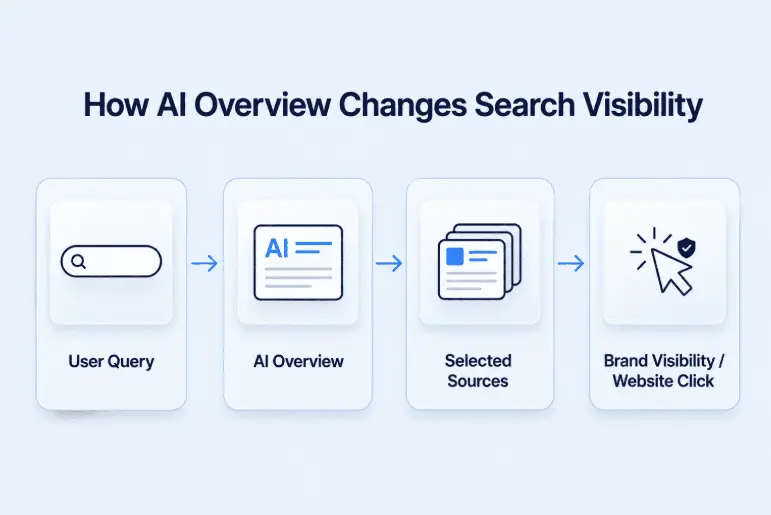
Traditional search journey: User query → Search results → Website click → User reads content AI Overview search journey: User query → AI Overview → Selected sources → User click or brand visibility In practice, this is where many businesses get confused. Their impressions may stay stable, but clicks can drop because the user has already received part of the answer before visiting the website. This does not mean SEO is dead. It means SEO needs to evolve. Your content now has to be easy to understand, easy to summarize, and useful enough to support an AI-generated answer. Businesses using AI development services, chatbots, or automation also need content that is structured clearly, because AI-driven systems depend on clean information architecture and accurate context.
Why Google AI Overview Is Part of a Bigger AI Visibility Shift
Google AI Overview is only one part of the bigger shift. People are also using tools like ChatGPT, Gemini, Perplexity, and voice assistants to compare services, understand topics, and shortlist companies.
This shift also connects with how businesses use AI and automation tools to manage visibility across different channels. You can also read our guide on social media automation using Slack, Postiz, and Gemini. That means businesses should not only ask,“Are we ranking on Google?” They also need to ask, “Are we being mentioned, trusted, and understood in the places where AI tools are shaping decisions?”This is why AI SEO is becoming less about one keyword and more about AI visibility across search results, answer engines, and generative platforms.
SEO vs AEO vs GEO: What Is the Difference?
SEO, AEO, and GEO are connected, but they do not focus on the same outcome. SEO helps pages rank in traditional search results, AEO helps content get selected for direct answers, and GEO helps content become easier for generative AI systems to understand, summarize, or reference.
SEO vs AEO vs GEO Table
| Type | Main Goal | What It Optimizes For |
|---|---|---|
| SEO | Rank in traditional search results. | Keywords, content quality, technical SEO, backlinks, and internal links. |
| AEO | Get selected for direct answers. | Clear answers, definitions, FAQs, concise formatting, and question-based headings. |
| GEO | Get cited or used by generative AI systems. | Entity clarity, topical depth, authority, structured context, and trustworthy information. |
For Google AI Overview, all three work together. Your content still needs traditional SEO foundations, but it also needs clear answer blocks for AEO and strong topical context for GEO.
Can You Actually Rank in Google AI Overview?
Yes, but not in the same way you rank in traditional organic results.
Traditional SEO ranking usually means your page appears in a fixed position, such as number one, number two, or number three.
Google AI Overview works differently. It may select different sources depending on the query, context, freshness, user intent, and how clearly the available content answers the question.
So instead of thinking only about “ranking,” think about being selected as a useful source. Your goal is to make the page:
- Easy to crawl
- Easy to understand
- Helpful for the searcher
- Strong enough to support an AI-generated answer
- Connected to related topics
- Trustworthy enough to reference
This is where AI SEO, Answer Engine Optimization, and traditional SEO start working together.
Why Some Pages Appear in AI Overview and Others Do Not
There is no public checklist that guarantees AI Overview placement. But from an SEO and content perspective, pages that have a better chance usually do a few things well. They answer the question directly. They explain the topic properly. They avoid vague filler. They use headings that match real user questions. They show enough context for Google to understand the page. They are crawlable and indexable. They connect with related content on the same website. They show real expertise instead of generic information.
A weak page may target the right keyword but still fail because it only gives a surface-level answer. A stronger page goes deeper. It answers the main question, then handles the next questions the user is likely to ask.
That is the difference between basic keyword SEO and AI-ready SEO.
What Research Suggests About AI Overview Visibility
There is still no guaranteed formula for appearing in AI Overview. The feature is evolving, but a few useful patterns are becoming easier to see. Pages that already have solid SEO foundations usually have a better chance. The content needs to answer the query clearly, explain the topic well, and come from a source that looks credible enough to trust. Strong rankings can help, but they are not the whole story. A page also needs to be easy to summarize, supported by related context, connected to the rest of the website, and trustworthy enough to be used as part of an AI-generated answer. This is why businesses should not treat AI Overview optimization as a separate trick. It works best when traditional SEO, answer-ready content, topical authority, technical health, and brand trust all support each other. One 2026 measurement study on Google AI Overviews supports this point. The study found that AI Overviews appeared for 13.7% of all tested queries and 64.7% of question-based queries. The same study also found that nearly 30% of AI Overview-cited domains did not appear in the co-displayed first-page organic results. In simple terms, ranking still matters, but AI Overview source selection does not always follow the same pattern as normal organic rankings.
How to Rank in Google AI Overview
1. Start With a Direct Answer
One common mistake I see in blogs is that they take too long to get to the actual answer.
When someone searches “how to rank in Google AI Overview,” they are not looking for a long build-up. They want to know what actually improves their chances of being selected.So start the page with a clear answer. Keep it short, useful, and easy to understand.
For example: “To improve your chances of appearing in Google AI Overview, your content should answer the query early, explain the topic properly, use clear headings, show relevance, and be technically easy for Google to crawl and understand.” This kind of answer works because it helps the reader immediately. It also gives search systems a clear section to understand, summarize, or use in answer-style results.
2. Match the Search Intent Properly
Search intent is the reason behind the query. Someone searching “Google AI Overview SEO” may want to understand how AI Overviews work. Someone searching “how to rank in Google AI Overview” wants practical steps. Someone searching “why did my traffic drop after AI Overview” wants a diagnosis. If your content does not match the intent, it will struggle even if the keyword appears many times. A strong page should answer:
- What Google AI Overview is
- Why it matters
- How Google may choose content
- How businesses should update content
- What mistakes to avoid
- How to measure AI search performance
- How traditional SEO and AI SEO work together
This helps your page cover the full search intent instead of only answering one small part of the topic.
3. Which Pages Should You Optimize for Google AI Overview First?
Not every page deserves the same level of AI Overview optimization. Start with pages that answer informational or educational queries, because those are more likely to trigger AI-generated answers.
Good pages to prioritize include:
- how-to guides
- comparison articles
- explainers
- FAQ-based pages
- problem-solving blogs
- service pages with strong educational sections
Comparison articles can work well for AI search because users are usually looking for a clear decision path. For example, a guide like WooCommerce vs Shopify comparison can help answer research-based queries before users choose a platform.
Bottom-funnel pages like pricing pages, contact pages, and direct sales landing pages should still focus more on traditional SEO, conversion, and trust signals.
4. Use Question-Based Headings
AI search and traditional search both benefit from clear headings. Avoid vague headings like:
- Overview
- Details
- Important Things
- More Information
Use headings people actually search for:
- What is Google AI Overview?
- How does Google choose sources for AI Overview?
- How do I optimize content for AI search?
- Can small businesses appear in AI Overview?
- Does schema help with AI Overview?
- How do I measure AI Overview performance?
This makes the content easier to scan. It also helps search systems understand which section answers which question.
5. Build Topic Depth, Not Just Word Count
Long content does not automatically rank.A long blog that repeats the same advice is not depth. It is just padding. A 2,000-word blog can still be weak if it repeats the same point again and again. Topic depth means covering the subject properly. For Google AI Overview, that may include:
- AI search optimization
- Answer Engine Optimization
- Generative Engine Optimization
- Search intent
- Semantic SEO
- Structured content
- Technical SEO
- Internal linking
- Authority signals
- Content freshness
- Helpful examples
Do not add these terms randomly. Explain them where they naturally fit.Google is much better at understanding topic meaning now. Your content should not just repeat the keyword. It should explain the subject clearly and completely. Google’s helpful content guidance also pushes site owners to create helpful, reliable, people-first content instead of content made mainly to attract search visits.
6. Make Content Easy to Extract
AI systems need to understand your content quickly. That does not mean writing like a machine. It means formatting your page in a way that is easy for both humans and search engines to read, scan, and understand. Use:
- Short paragraphs
- Clear headings
- Bullet points
- Comparison tables
- Definition blocks
- Practical examples
- Step-by-step sections
- Summary sections
For example, if your page explains AI Overview optimization, include a short checklist. This makes the page more useful for readers and easier for search systems to interpret.
Content structure is not only a writing issue. Strong custom web development also supports clean website setup, fast pages, proper heading structure, and crawlable layouts, all of which affect how easily search engines understand your content.
7. Strengthen Brand and Author Signals
AI Overview visibility is not only a page-level issue. It also depends on whether the brand and author look trustworthy. Add an author bio, connect related content, keep business information consistent, and build mentions on trusted platforms where possible.
8. Update Existing Pages Before Writing New Ones
If a page already has impressions or rankings, improving it may work faster than starting from zero. Add a direct answer, improve headings, update outdated points, add examples, and link it to related service pages or supporting blogs.
9. Track Queries Where Clicks Drop but Impressions Stay Strong
In Google Search Console, watch for pages where impressions are steady but clicks are dropping. These queries may be affected by AI Overviews, featured snippets, or zero-click behavior. Those pages should be prioritized for AI search optimization.
Google AI Overview SEO Checklist for 2026
Google AI Overview SEO Checklist Table
| Checklist Item | Why It Matters |
|---|---|
| Answer the main query in the first few lines | Helps users and search systems understand the page quickly. |
| Use question-based headings | Matches how users search and how AI systems process answers. |
| Cover related questions naturally | Builds topical depth. |
| Avoid keyword stuffing | Keeps the content useful and natural. |
| Add internal links to related pages | Helps Google understand your site structure. |
| Keep the page crawlable and indexable | Allows Google to access the content. |
| Add practical examples | Makes the content more useful and less generic. |
| Update the content regularly | Keeps the information fresh. |
| Show real expertise | Builds trust and credibility. |
| Write for people first | Aligns with Google’s content quality direction. |
This checklist will not guarantee AI Overview placement, but it puts your content in a much stronger position.
Weak Page vs AI-Ready Page
Let’s say two companies publish a blog about AI SEO services.
Website A: Basic SEO Page
Website A writes a page that repeats “AI SEO services” several times. It explains that AI SEO is important, lists a few benefits, and ends with a sales CTA. The page may be optimized for a keyword, but it does not explain much. It does not explain how AI search works. It does not discuss Google AI Overview. It does not explain Answer Engine Optimization. It does not show how businesses should update existing content. It does not answer follow-up questions. Result: the page may rank for low-competition terms, but it gives Google and users limited value.
Website B: AI-Ready Page
Website B targets the same keyword, but it goes deeper. It explains what AI SEO includes, how AI Overview changes search visibility, how content should be structured, why answer blocks matter, how internal links support topic authority, and how businesses can measure traffic changes. It also includes practical examples, clear headings, and useful FAQs written for readers. Result: the page is not only keyword-optimized. It is easier for Google and AI search systems to understand, summarize, and trust. Here is a simple before-and-after example:
Weak answer:
“AI Overview helps users find answers faster. Businesses should optimize content for AI search.”
Better answer:
“Google AI Overview summarizes answers directly in search results. To improve visibility, your content should answer the main query early, use question-based headings, explain related topics, and support claims with credible sources.”
The better version is stronger because it explains what AI Overview does, gives clear optimization actions, and adds trust by mentioning credible sources.
That is the difference between writing a ranking page and building an answer-ready page.
Brand Signals Also Matter for AI Overview Visibility
A strong page helps, but the brand behind the page matters too. If your business is mentioned across trusted websites, industry platforms, directories, reviews, social channels, and relevant communities, search systems get more signals that your brand is real and credible
For service businesses, this matters even more because buyers rarely trust one blog post alone. They usually check the company website, LinkedIn presence, reviews, case studies, and whether the brand looks active and credible.
This does not mean you should spam forums or chase random backlinks. It means building a consistent presence where your audience already looks for answers, such as industry platforms, relevant communities, expert articles, and useful social content.
Does Structured Data Help With Google AI Overview?
Structured data can help Google understand your page, but it does not guarantee AI Overview visibility. Google’s guidance says there is no special schema markup required for generative AI search . Use schema to support content clarity, not as a shortcut for rankings. The content itself still needs to be useful, accurate, crawlable, and aligned with the user’s search intent.
For blogs and service pages, useful structured data may include:
- Article schema
- BlogPosting schema
- Organization schema
- Breadcrumb schema
- Author information
- Service schema where relevant
However, structured data should not be treated as a shortcut. Google explains that structured data helps Google understand page content, but rich results are not guaranteed , even when the markup is technically correct. It supports understanding, but it does not replace helpful content, topical authority, technical SEO, or trust.
Should You Still Use FAQs?
Yes, but for the right reason.FAQs are still useful because they help users find quick answers. They also help your page cover follow-up questions naturally.
But FAQ schema should not be treated as a major visibility tactic anymore.
Google states that FAQ rich results are now mainly limited to well-known government and health websites, so the real value of FAQs is content clarity, not schema manipulation.
Use FAQs to answer real user questions, not just to add keywords.
Good FAQs should be:
- Short
- Clear
- Relevant to the main topic
- Based on real search intent
- Helpful without repeating the same answer
Common Mistakes That Hurt AI Overview Visibility
1. Writing Only for Keywords
Adding “Google AI Overview SEO” many times will not make a weak page useful. Google understands topic meaning much better now. Your content needs to explain the subject clearly, not just repeat the phrase.
2. Ignoring the Next Question
A good answer does not stop too early. If someone asks how to rank in AI Overview, they may also want to know:
- How AI Overview affects traffic
- Whether schema matters
- Whether backlinks still help
- How to measure AI search performance
- How to update old blogs
- How to structure service pages for AI search
Covering these follow-up questions makes the page stronger.
3. Publishing Generic AI-Written Content
AI tools can help with research, structure, and drafts. But publishing generic AI-written content without human review, real examples, and practical insight is risky. The problem is not AI itself. The problem is low-value content. Use AI as support, not as a replacement for strategy, expertise, and judgment.
4. Depending Only on Schema
Schema can help search engines understand content, but it is not a magic key to AI Overview. Do not expect schema to fix weak content. Use structured data where it makes sense, but focus first on content quality, clarity, and usefulness.
5. Writing Long Introductions Before Giving the Answer
Long intros can hurt user experience. If the user came for an answer, give the answer early. You can explain the details afterward. This is especially important for AI search because clear answer blocks are easier to understand and extract.
How to Optimize Existing Blogs for Google AI Overview
You do not always need to create a new blog from scratch. Many existing blogs can be improved for AI Overview and AI search visibility. Start by reviewing your old content and asking:
- Does the blog answer the main question quickly?
- Are the headings clear and question-based?
- Does the content cover related questions?
- Is the information current?
- Are there internal links to relevant service pages?
- Is the content written in a helpful, expert tone?
- Does the page include examples or only generic advice?
- Is the page technically crawlable and indexable?
Then update the blog with:
- A direct answer section near the top
- Better headings
- More practical examples
- Updated statistics or references where needed
- Stronger internal links
- Clearer formatting
- A better CTA
- A concise FAQ section
This is one of the easiest ways to improve AI SEO without publishing dozens of new pages.
How Internal Linking Helps AI Search Visibility
Internal linking is still important. It helps Google understand how your website topics are connected. For example, a blog about Google AI Overview can naturally link to:
- AI SEO services
- Digital marketing and SEO services
- AI development services
- Custom web development services
- Related blogs about AEO, GEO, semantic SEO, and technical SEO
This helps build topical authority. It also guides users toward the next logical step. For example, if a reader learns about AI Overview optimization, they may also need help improving their website structure, content strategy, and technical SEO. That is where a relevant internal link to your SEO services page can support both rankings and conversions.
Our AI SEO services help businesses improve visibility across Google Search, AI Overviews, and answer-style search results.
How to Measure AI Overview and AI Search Performance
AI Overview reporting is still evolving, and you may not always get perfect data for every appearance. But you can still monitor important signals. Track:
- Impressions in Google Search Console
- Click-through rate changes
- Average position
- Queries with high impressions but lower clicks
- Traffic changes on pages affected by AI summaries
- Branded search growth
- Organic leads and conversions
- Engagement on key landing pages
- Performance of updated content
Simple Monthly AI Overview Tracking Workflow
- Pick 20 to 30 important informational keywords.
- Search each keyword manually in Google and note whether AI Overview appears.
- Record which competitors are cited.
- Check whether your page appears as a source.
- Track changes in Google Search Console impressions, CTR, and average position.
- Repeat the process every month.
This will not give perfect attribution, but it helps you see whether your AI visibility is improving or competitors are taking the answer space. Do not judge performance only by clicks. In AI search, visibility may also show up through brand awareness, assisted conversions, and users discovering your business before they click.
Is Google AI Overview Replacing SEO?
AI Overview is not replacing SEO. It is changing how SEO works. Traditional SEO still focuses on rankings, technical optimization, keywords, backlinks, and organic traffic. AI SEO goes further by making content easier for AI search systems to understand, summarize, and use in answer-style results. For a deeper comparison, read our complete guide on AI SEO vs Traditional SEO.
Final Take
Ranking in Google AI Overview is not about finding a shortcut or tricking the algorithm. The real goal is to make your content clear enough for users, structured enough for search engines, and trustworthy enough for AI systems to use as part of an answer. Traditional SEO still matters. But in 2026, it cannot work alone. It needs to connect with AI SEO, Answer Engine Optimization, Generative Engine Optimization, technical SEO, and a stronger content strategy. The brands that win will not be the ones publishing the most content. They will be the ones publishing answers that are clear, useful, current, and backed by real trust. So if your business is reviewing its SEO strategy, do not only ask whether your pages are ranking. Ask whether your content is actually helping users understand the topic better than the pages around it.