Choosing between 𝗪𝗼𝗼𝗖𝗼𝗺𝗺𝗲𝗿𝗰𝗲 𝘃𝘀 𝗦𝗵𝗼𝗽𝗶𝗳𝘆 is one of the most common decisions new and growing online businesses face. At first glance, both platforms appear to do the same thing. They allow you to create an online store, list products, accept payments, and ship orders.
But once you move past the basics, the differences become more meaningful. This comparison is not only about features. It is about how each platform behaves as your business grows, how much control you retain, and how deeply your store can integrate with the rest of your technology stack.
If you’re choosing a platform as a growth foundation, it helps to think like an eCommerce website development project, not a theme selection.
This guide starts simple, then goes deeper, so it works whether you’re launching your first store or managing a complex eCommerce setup.
Quick answer:
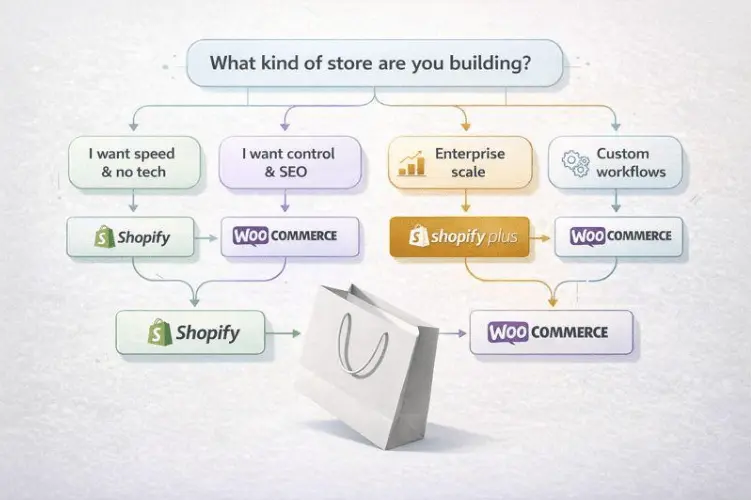
Shopify is best if you want a fully managed platform that scales without technical effort. WooCommerce is better if you want full control, deeper SEO flexibility, and custom workflows as your business grows.
What Is Shopify?
Shopify is a fully hosted eCommerce platform. This means Shopify provides the infrastructure that powers your store, including hosting, security, performance optimization, and updates.
From a beginner’s perspective, Shopify feels straightforward. You sign up, choose a theme, add products, connect payment methods, and start selling. You do not need to worry about servers, caching, or software updates.
This simplicity is why Shopify is often recommended to:
⦁ first-time store owners. ⦁ non-technical founders. ⦁ brands that want to launch quickly.
Shopify is designed to remove technical friction so business owners can focus solely on marketing, branding, and sales.
What Is WooCommerce?
WooCommerce is an open-source eCommerce plugin for WordPress. Instead of being a complete platform, it extends WordPress with eCommerce functionality.
This means you are responsible for:
⦁ choosing a hosting provider ⦁ managing updates ⦁ handling performance and security ⦁ deciding how the store is structured
For beginners, this can feel more complex than Shopify. But for businesses that need flexibility, WooCommerce becomes powerful very quickly.
WooCommerce is widely used by:
⦁ agencies
⦁ SEO-driven brands
⦁ businesses with custom workflows
⦁ companies that treat their website as a long-term system
Educational Insight: How Shopify’s Platform Structure Differs From WooCommerce
You may come across searches like 𝗦𝗵𝗼𝗽𝗶𝗳𝘆 𝗲𝗰𝗼𝗺𝗺𝗲𝗿𝗰𝗲 𝗽𝗹𝗮𝘁𝗳𝗼𝗿𝗺 𝗶𝗱𝗲𝗻𝘁𝗶𝗳𝗶𝗰𝗮𝘁𝗶𝗼𝗻 𝗺𝗲𝘁𝗵𝗼𝗱𝘀 or 𝗦𝗵𝗼𝗽𝗶𝗳𝘆 𝗲𝗰𝗼𝗺𝗺𝗲𝗿𝗰𝗲 𝗽𝗹𝗮𝘁𝗳𝗼𝗿𝗺 𝗱𝗲𝘁𝗲𝗰𝘁𝗶𝗼𝗻 𝗺𝗲𝘁𝗵𝗼𝗱𝘀. These searches are not about curiosity alone. They exist because Shopify operates as a highly standardized platform, and that standardization has real implications for scalability, performance, and customization.
If you’re not a developer, you can ignore the phrase itself, but the concept behind it explains a lot about how Shopify and WooCommerce behave as stores grow.
From an architectural point of view, most Shopify stores share:
⦁ similar checkout behavior
⦁ consistent theme structures
⦁ platform-managed scripts and assets
⦁ uniform handling of caching and performance
This consistency makes Shopify stores predictable. From a business perspective, predictability means fewer surprises when traffic increases, updates roll out, or integrations are added.
WooCommerce works differently.
Because WooCommerce is built on WordPress and self-hosted infrastructure, two WooCommerce stores can behave very differently. Performance, structure, and scalability depend on:
⦁ hosting environment ⦁ theme quality ⦁ plugin choices ⦁ custom development decisions
This variability is not a flaw. It is the trade-off.
In simple terms:
⦁ Shopify’s standardized structure prioritizes stability and operational consistency
⦁ WooCommerce’s flexible structure prioritizes customization and technical control
Understanding this difference helps explain why Shopify often scales smoothly with minimal intervention, while WooCommerce offers deeper control but requires more technical decision-making as stores grow.
WooCommerce vs Shopify at a glance
| Area | Shopify | WooCommerce |
|---|---|---|
| Setup | Fast, guided | Flexible, more decisions |
| Hosting | Included and managed | You choose hosting |
| Scalability | Automatic scaling handled by Shopify | Scales based on hosting + architecture |
| Customization | Strong, but within platform limits | Full control (code, DB, workflows) |
| Checkout customization | Built-in editor and apps; deeper extensions are mainly Shopify Plus | Fully customizable (theme, plugins, custom code) |
| SEO control | Solid defaults; some platform constraints | Deep SEO control via WordPress + plugins |
| Payments | Shopify Payments available only in supported countries; third-party fees may apply | Wide gateway flexibility; depends on plugins/provider |
| Maintenance | Shopify handles updates/security | You manage updates/security (or your host/agency does) |
| Best fit | Brands wanting simplicity and stability | Brands needing flexibility and long-term control |
Scalability: How Shopify and WooCommerce Platform Handles Growth
Shopify Scalability
Shopify is built to scale automatically. When traffic increases due to paid advertising, influencer campaigns, or seasonal sales, Shopify adjusts server resources in the background.
You do not manage load balancing, caching layers, or database optimization. This makes Shopify appealing for brands that expect unpredictable traffic spikes.
WooCommerce Scalability
WooCommerce scalability depends on architecture. Performance is influenced by:
⦁ hosting quality ⦁ caching strategies ⦁ database optimization ⦁ plugin efficiency ⦁ CDN configuration
With the right setup, WooCommerce can scale very effectively, but it requires planning or technical support.
In short:
⦁ plugin efficiency
⦁ CDN configuration
Cost Breakdown and Long-Term Ownership
Shopify Costs
Shopify costs include:
⦁ monthly subscription fees ⦁ paid apps for additional functionality ⦁ transaction fees when not using Shopify Payments
Costs are predictable, but app dependencies often increase over time.
WooCommerce Costs
WooCommerce itself is free, but businesses pay for:
⦁ hosting ⦁ premium plugins ⦁ maintenance ⦁ development time when customization is required
This leads many people to ask 𝗵𝗼𝘄 𝗺𝘂𝗰𝗵 𝗱𝗼𝗲𝘀 𝗪𝗼𝗼𝗖𝗼𝗺𝗺𝗲𝗿𝗰𝗲 𝗰𝗼𝘀𝘁. The honest answer depends on how the store is built and maintained.
That is why it is more accurate to 𝗲𝘅𝗽𝗹𝗮𝗶𝗻 𝘁𝗵𝗲 𝘁𝗼𝘁𝗮𝗹 𝗰𝗼𝘀𝘁 𝗼𝗳 𝗼𝘄𝗻𝗲𝗿𝘀𝗵𝗶𝗽 𝗳𝗼𝗿 𝗦𝗵𝗼𝗽𝗶𝗳𝘆 𝗮𝗻𝗱 𝗪𝗼𝗼𝗖𝗼𝗺𝗺𝗲𝗿𝗰𝗲 rather than compare base prices.
Payment Methods and Shopify Payments Limitations
A frequent concern is 𝗽𝗮𝘆𝗺𝗲𝗻𝘁 𝗺𝗲𝘁𝗵𝗼𝗱𝘀 𝗹𝗶𝗺𝗶𝘁𝗲𝗱 𝗦𝗵𝗼𝗽𝗶𝗳𝘆 𝗣𝗮𝘆𝗺𝗲𝗻𝘁𝘀. Shopify Payments simplifies setup, but:
⦁ it is not available in all countries ⦁ some business models require third-party gateways ⦁ additional transaction fees may apply
WooCommerce does not impose platform-level payment restrictions, giving businesses more freedom in choosing payment processors.
SEO Capabilities
WooCommerce SEO
WooCommerce provides deep SEO control, making it attractive for content-led growth:
⦁ full URL customization ⦁ advanced schema control ⦁ flexible internal linking ⦁ powerful blogging through WordPress
If organic growth is your priority, investing in SEO and digital branding matters as much as the platform choice.
Shopify SEO
Shopify offers strong default SEO:
⦁ clean structure ⦁ good performance ⦁ fewer technical errors
However, some advanced technical SEO customizations are limited by the platform.
Integrations and Tech Stack Compatibility
As stores grow, eCommerce platforms rarely operate in isolation. They connect to email platforms, CRMs, ERPs, inventory systems, analytics tools, and custom internal software. How easily a platform integrates into a broader tech stack becomes increasingly important over time.
Shopify Integrations
Shopify relies heavily on its app ecosystem for integrations. Many popular tools for email marketing, subscriptions, shipping, analytics, and fulfillment connect quickly through the Shopify App Store.
This makes Shopify well suited for:
⦁ fast setup with common SaaS tools ⦁ non-technical teams that want plug-and-play connections ⦁ standardized workflows across tools
The trade-off is that deeper or unusual integrations may:
⦁ require paid apps
⦁ need middleware
⦁ require Shopify Plus for advanced access
WooCommerce Integrations
WooCommerce integrates at a different level. Because it runs on WordPress and allows direct access to code and databases, integrations can be built or customized more freely.
This works well for:
⦁ custom CRM or ERP connections ⦁ complex inventory or fulfillment logic ⦁ internal dashboards and automation ⦁ hybrid B2B and B2C workflows
WooCommerce often requires more setup, but it offers more flexibility for businesses that need systems to talk to each other in specific ways.
Integration Comparison Summary
⦁ Shopify prioritizes speed and consistency through apps ⦁ WooCommerce prioritizes flexibility and direct system control
If your business relies on standard tools and fast deployment, Shopify integrations are usually sufficient. If your business relies on custom designed websites, workflows or internal systems, WooCommerce offers more long-term adaptability.
WooCommerce to Shopify Plus: When Businesses Switch
As businesses scale, some explore 𝗪𝗼𝗼𝗖𝗼𝗺𝗺𝗲𝗿𝗰𝗲 𝘁𝗼 𝗦𝗵𝗼𝗽𝗶𝗳𝘆 𝗣𝗹𝘂𝘀. This often happens when:
⦁ traffic spikes become difficult to manage ⦁ infrastructure maintenance becomes costly ⦁ infrastructure maintenance becomes costly ⦁ enterprise-level support is required
Shopify Plus offers stability and scalability, but at the expense of flexibility and higher recurring costs.
Shopify Versus WordPress: Broader Context and Why It Matters
Another comparison that often appears alongside 𝗦𝗵𝗼𝗽𝗶𝗳𝘆 𝘃𝗲𝗿𝘀𝘂𝘀 𝗪𝗼𝗿𝗱𝗣𝗿𝗲𝘀𝘀 is not really about two eCommerce platforms. It is about two very different philosophies for building and owning a website.
WordPress is an open-source content management system designed to be extended. When paired with WooCommerce, it becomes a highly customizable eCommerce solution where the website, content, and store all live under the same system.
Shopify, on the other hand, is a closed, managed eCommerce platform. It is not built on WordPress and does not function as a general-purpose CMS in the same way.
Shopify is designed to keep things structured, predictable, and controlled.
This difference matters more than it first appears.
Content and SEO Implications
With WordPress and WooCommerce, content is first-class. Blogging, landing pages, long-form guides, and complex content structures are native to the platform. This is one reason SEO-driven businesses often prefer WordPress. You have full control over URLs, internal linking, schema, and how content supports product pages.
Shopify also supports blogging and content, but it is commerce-first. Content tools are simpler, and while they work well for many brands, they are not as flexible as WordPress when content becomes a primary growth channel.
In short:
⦁ WordPress + WooCommerce favors content-led and SEO-heavy strategies
⦁ Shopify favors commerce-led strategies with lighter content needs
Ownership and Control
WordPress with WooCommerce gives you ownership over:
⦁ hosting environment ⦁ database and files ⦁ site structure ⦁ long-term portability
You can move hosts, change architectures, or rebuild parts of the system without leaving the platform.
Shopify offers convenience but with guardrails. Your store lives inside Shopify’s ecosystem. You can export data, but you cannot take the platform itself with you. This trade-off is acceptable for many businesses, but it is an important distinction for companies thinking long-term.
Flexibility vs Simplicity
The WordPress ecosystem is vast. With WooCommerce, you can:
⦁ create custom post types and taxonomies ⦁ blend content and commerce deeply ⦁ build hybrid B2B and B2C experiences ⦁ extend functionality with custom code
Shopify limits complexity on purpose. It reduces the chance of breaking things and keeps stores stable, but it also means certain ideas must fit within Shopify’s rules.
This is why:
⦁ agencies and technical teams often lean toward WordPress + WooCommerce
⦁ non-technical founders often lean toward Shopify
How This Ties Back to WooCommerce vs Shopify
Understanding Shopify versus WordPress helps explain many of the differences discussed earlier in this guide.
WooCommerce inherits WordPress’s flexibility, extensibility, and SEO depth.
Shopify inherits the strengths and limits of a managed, closed platform.
Neither approach is wrong. They simply serve different priorities.
If your website is mainly a storefront, Shopify often makes sense.
If your website is a long-term digital asset built around content, SEO, and customization, WordPress with WooCommerce usually offers more room to grow.
WooCommerce Alternatives: What They Are, Who They’re For, and When to Avoid Them
When people search for 𝗪𝗼𝗼𝗖𝗼𝗺𝗺𝗲𝗿𝗰𝗲 𝗮𝗹𝘁𝗲𝗿𝗻𝗮𝘁𝗶𝘃𝗲𝘀, they’re usually in one of these situations:
⦁ They like WordPress, but WooCommerce feels heavy or too technical ⦁ They want fewer plugins and less maintenance ⦁ They’ve outgrown a basic store and need more structure ⦁ They want a platform that “just works” without a developer on standby
The problem is that “alternatives” can mean very different things depending on what you’re optimizing for: ease, cost, flexibility, SEO, B2B features, or enterprise operations.
Here are the main categories people actually consider, and what’s worth knowing before you switch.
Quick comparison of common WooCommerce alternatives
| Platform | Best for | Where it wins | Where it disappoints |
|---|---|---|---|
| Shopify | Most DTC brands | Stability, speed to launch, app ecosystem | Deep backend control, some platform constraints |
| BigCommerce | Growing catalogs, mid-market | More built-in features than Shopify in some areas | Smaller ecosystem than Shopify, less flexible than WooCommerce |
| Squarespace | Small catalogs, design-first | Beautiful templates, simple setup | Scaling, complex filtering, deep integrations |
| Wix | Simple small stores | Quick setup, lots of templates | Not ideal for serious scale or complex SEO workflows |
| Magento (Adobe Commerce) | Enterprise, complex ops | Extreme power and customization | Cost, complexity, requires strong dev team |
| Headless (custom stack) | Brands with strong engineering | Full control, performance tuning | Higher build cost, ongoing dev responsibility |
Shopify vs WooCommerce vs BigCommerce: Where BigCommerce Fits
When people search 𝗦𝗵𝗼𝗽𝗶𝗳𝘆 𝘃𝘀 𝗪𝗼𝗼𝗖𝗼𝗺𝗺𝗲𝗿𝗰𝗲 𝘃𝘀 𝗕𝗶𝗴𝗖𝗼𝗺𝗺𝗲𝗿𝗰𝗲, they are usually looking for a middle ground between convenience and control.
BigCommerce is a hosted eCommerce platform like Shopify, but it includes more built-in features out of the box. In some cases, this reduces reliance on third-party apps.
Where BigCommerce performs well:
⦁ larger product catalogs ⦁ multi-channel selling ⦁ structured feature sets without heavy app usage
Where it falls short compared to WooCommerce:
⦁ limited deep customization ⦁ smaller developer and plugin ecosystem ⦁ less flexibility for custom workflows
Where it falls short compared to Shopify:
⦁ fewer themes and integrations ⦁ smaller agency and partner ecosystem ⦁ slower innovation pace in some areas
In practice, BigCommerce can work well for businesses that want more structure than WooCommerce but less app dependence than Shopify. However, it rarely replaces WooCommerce for flexibility or Shopify for ecosystem strength.
Evaluating Squarespace Alongside Shopify and WooCommerce
Searches like 𝗲𝘃𝗮𝗹𝘂𝗮𝘁𝗲 𝘁𝗵𝗲 𝗲-𝗰𝗼𝗺𝗺𝗲𝗿𝗰𝗲 𝗽𝗹𝗮𝘁𝗳𝗼𝗿𝗺𝘀 𝗰𝗼𝗺𝗽𝗮𝗻𝘆 𝗦𝗾𝘂𝗮𝗿𝗲𝘀𝗽𝗮𝗰𝗲 𝗼𝗻 𝗦𝗵𝗼𝗽𝗶𝗳𝘆 𝘃𝘀. 𝗪𝗼𝗼𝗖𝗼𝗺𝗺𝗲𝗿𝗰𝗲 usually come from early-stage businesses.
Squarespace is primarily a design-first website builder with eCommerce capabilities added on top.
Squarespace makes sense if:
⦁ you sell a small number of products ⦁ design and branding matter more than scale ⦁ you want minimal setup and maintenance
However, when compared directly:
⦁ Shopify offers stronger commerce tools and scaling support ⦁ WooCommerce offers deeper customization, SEO control, and extensibility
For growing stores, Squarespace often becomes a stepping-stone rather than a long-term platform.
Quick Comparison Snapshot
| Platform | Best suited for |
|---|---|
| Shopify | Fast-growing DTC brands that want stability |
| WooCommerce | Businesses needing control, SEO depth, and customization |
| BigCommerce | Mid-market stores wanting built-in features |
| Squarespace | Small catalogs and design-first sites |
Final Take: Choosing Between WooCommerce and Shopify With Clarity
After comparing WooCommerce and Shopify across cost, scalability, SEO, integrations, customization, and long-term ownership, one thing becomes clear: this is not about which platform is better. It’s about which platform aligns with how your business actually operates and evolves.
Shopify is best suited for businesses that want a managed system with minimal technical responsibility. It excels for brands that prioritize speed, stability, and marketing execution over deep customization. If your goal is to launch quickly, run campaigns efficiently, and keep infrastructure concerns out of sight, Shopify delivers exactly that.
WooCommerce is a stronger fit when your website is more than just a storefront. If content, SEO, custom workflows, or system integrations are central to your growth strategy, WooCommerce offers the flexibility and ownership needed to support that long term. It requires more decisions and ongoing care, but that investment is rewarded with control.
The trade-off remains consistent:
Shopify favors convenience and predictability.
WooCommerce favors control and extensibility.
The real question is not which platform is better, but which one you want to build around long term. Once those factors are clear, the choice between WooCommerce and Shopify usually becomes obvious.